A change

Things are changing riverside. This spring has had a slow rolling start. Every season the river comes alive in April. The hills green, the trees bud, the birds return, the otter play, bugs hatch, the days warm, the winds change, the smells invigorate, and the trout eat. One other thing I wait for amd anticipate most of all in the spring. Runoff.

The Yakima is a tailwater. Meaning her flow is dictated by dams. She has a few smaller tributary streams like the Teanaway, Tanuem, Wilson Creek, Swauk Creek and others. All small waters flow into the Yakima. This time of year all those little waters swell with snow melt and rain. Gushing into the river system. These events charge the river with nutrients, minerals, food, debris, organic material, and all other sorts of good things. It is natural and beautiful. We also mimic this event with salmon pulses prior to irrigation water being diverted into the Yakima for agriculture.

This time of year the river is as close to natural as she ever gets. Stifled by dams but allowed to breath. Salmon return as do steelhead, to spawn. The trout also begin to spawn. Small salmon smolt are flushed downward towards the ocean journey that will eventually bring them back.

The swelled creeks and high water giving access to rearing grounds and safe water for all species to spawn in. The dams begin to pulse the river, the water levels rise as if rain and snowmelt are filling the Yakima. They are, just controlled. If not, the Yakima would rage and torrent this valley every season rising high above 20,000 cfs, cutting earth and rock as it tumbles towards the confluence with the Yakima. Flooding and cutting new paths without mercy or regard. A vast wetland would form where most fields and farms are. There would be groves of trees thick and rooted shallow where buildings and streets stand. It would be a sight to behold.

But the Yakima is tamed, save for her trout and the wild things that call her home. As the flows come up from the dams, the river acts naturally. Flushing the system and bringing life to all it touches.

I love it when this happens. I look forward to it every year. It brings about change to the river that gives more life and experience to those that interact with it during this time of year. The flows make trout move, which makes them feed. The river gives them insects and small fish and river critters, plenty to nourish them as they survive the coming season.

This time of year allows the angler to become a part of this world through a fly and rod. Experiencing it through wild trout. Trout allow an angler to tap into the intricate natural river world and connect with it intimately. To feel its flow and power through countering and playing a fish against its current. To enter into that world with a fly that mimics the natural so well when presented adequately, is to put the key into the lock, when the trout eats the lock is turned and the door is opened, entering into the river almost like a stumble through the door and into the swift waters before you. It’s enveloping and amazing.

And while the river needs its time to transition, for all that it touches to adapt and change with it, we patiently wait. As it does more and more moments to be invited into that world as an angler become abundant. It entices and invites. Delivering excitement, peace, clarity, healing, and awe-inspiring natural experiences, unlike most things that can be done outside and near water. It intoxicates.

The ability to find yourself lost in an entire day riverside experiencing everything as it flows by, around, through, toward, and away from you. The river speaks more as it changes and has more to share. These rivers, these fish we chase, this craft we invest ourselves into, brings us things we sometimes can not explain but only experience and enjoy. The river gives us a day and we flow with it. Hoping to be invited in. To be shown something amazing. To hold ourselves in awe, stunned at what the river shares and puts forward. To be humbled, excited, calmed, delighted, exuberant, respectful, and thankful that the river invited us in.

Things are changing. Let’s go see how.

Tamarack
Guide Life

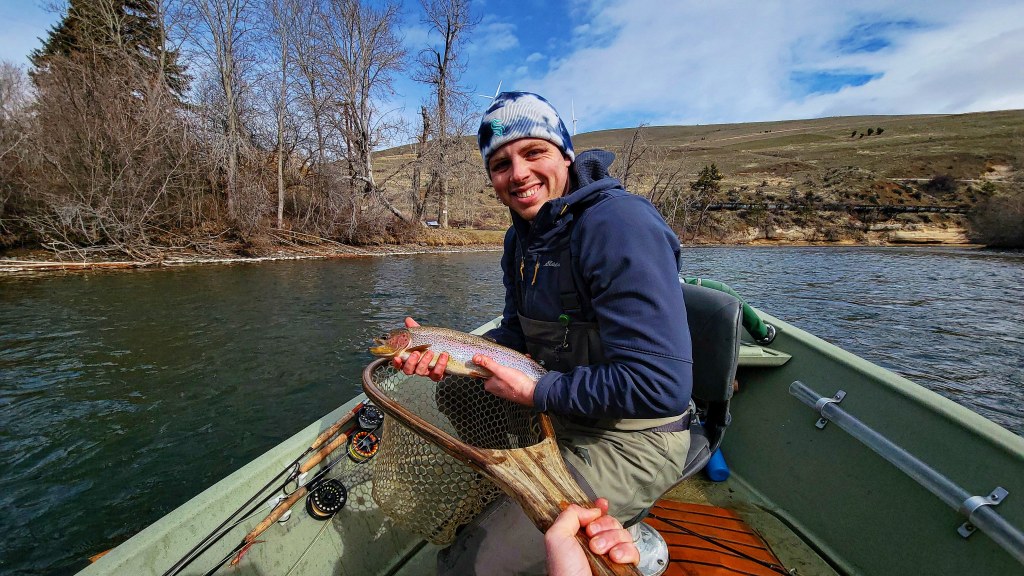
The river was quiet today. I love guiding on overcast dreary but warm days. Good sweatshirt weather guiding. Today was rain jacket weather, which I’ve never minded. It’s why we have those expensive jackets. They do work. Rainy days are always a little slower, little more chill, sometimes they give tremendous fishing. Today wasn’t that day.

Guiding isn’t just about the fish. It’s a good part of it don’t get me wrong. But it only ever takes one good fish anglers. Only 1. I’ve been fishing this river for a long time and I’ve done a lot of guide trips. Met a lot of anglers. It only takes one.  That’s all I need to say.  Guiding comes down to 80 percent people and 20 percent fishing. The fishing part of guiding has a steep learning curve but once you get through it the fishing takes care of itself.

Here’s an easy breakdown of what I mean on a slow day of fishing when that 20 percent really matters. I guided in tandem in a short 4-mile float with a very experienced guide. One who trained me. We work well together. We got into 6 or so fish between the two of us.

Here’s my breakdown for my boat:

Nymphing. Started out single weighted pats coffee size 6, 4.5 feet down. Nymphing 4 to 6 foot shelf and boulder water with minimal current but near or next to moderate speed water current. Long 20 to 30 foot drifts, following with boat, light oar strokes to allow for mending at 90 degrees to the boat. Front boat angler fishing 10 to 15 feet out of the front of the boat, back anglers fishing outside lanes 15 to 20 feet from the boat. Drifts are 45 back up stream mending, in the zones by 90 degrees to the boat, 15 to 20 feet of drift from 90 degrees following with boat to 45 degrees downstream, recast. 1 to 3 drifts and casts through water. Holding line 100 to 300 yards at a time.

One fish 2nd cast 12 inches. Ran those lines river left and right for half a mile. Added second fly, pheasant tail Jig tungsten bead, and added split shot 10 inches above lead fly. Adjusted indicators to 5.5 feet to bottom fly adjust rowing lines for slightly deeper slower water, ran for 600 yards. Nothing.

At this point saw other boat in different lines hit a fish. Held my lines for 10 more minutes, adjusted, and ran a secondary line behind other guides, with no success. Came to a stop and changed to olive pats and smaller mayfly trailer fly, same depth and split shot. Ran slower water at 4 to 6 foot depth. May have missed 1.

Switched to dry dropper. Fished 1 to 4 feet off the bank with a size 14 Jig head pheasant tail, 16 inches under a skwalla dry. Nothing for 600 yards. Other guide had one come up for skwalla when stopped agin. Waited for 30 minutes for bugs, coming up on 2pm.

Small hatch more rain, moved on with dry dropper rig, working tight water going slow. Ran laps on a 80 yard stretch 2 times once with dries bank lane tight, and then again with previous nymph rig. Other guide ran different rigs similarly. May have missed 1.

Nymphed for a mile targeting various types of water speed at 4 to 6 feet depth. Went to 8 to 9 feet in slower deeper water. Saw risers and skwallas on the river. Switched to dry droppers. Other guide hit one on dry landed. Ran 3 laps 2 with dries 1 with nymphs on a 80 yard stretch. Nothing. Ran 3 laps in back eddy with dry droppers, nothing. Saw large trout rise. Got out and casted to it with no love. Other guide caught up, no love for them. Take out nearing, 6 love. Other guide gets take out trout. Hear two rise. Back row and run laps 3 times. Rain comes on. No love. Take out.

That’s the 20 percent of fishing and rowing of a half day float on a slow day.

The other part of the trip, the 80 percent is people. It’s teaching anglers how to cast. Why we are using these flies, why we are fishing this water, why we are changing, waiting, what are we seeing. Stories, fishing and life related. Snack and pee breaks. Re rigging flies. Untangling 6 to 24 times. Losing 2 to 20 flies. Only 4 today.

Keeping the energy and the vibe of the boat up. Talking about the river, answering questions like where mayflies hatch, and what bug is that, what is that bird, why do the trout have spots. Are there Brown Trout? Why not. It’s checking in with clients, seeing if they are in good spirits, making sure they are understanding all the why, what, how, of our process and getting stoked even if the fishing is slow. Laughing, having a good time. Putting that energy out there, and keeping it up and there no matter the fishing. That’s a good chunk of the people part. If they are experienced anglers. New anglers or kids is a whole other thing.

That’s just part of the work that goes into a single guide day. It came with several days on water prior dialing it in similar and different ways in different water. It’s looking at flows, water temps, miles of river to do in what amount of time, where to be and when to get best results, what water is coming up, what the weather is doing, did do, and might do, this is all done as I get to the river. I’m on river then I’m in it.

I’ve also gotten fuel, lunches, which are expenses, I’ve bought or tied flies both of which have cost, I’ve bought leader and tippet, I’ve lubed bearings, checked lights, got boxes organized, gear ready, boat prepped. I launch and take out the boat. I run a shuttle. Get off river. Take a shower if I can. Eat dinner by 8 if I’m lucky. I’m in bed by 11 ish, up at 7 ish to get it going again.

I squeeze social media posts, phone calls, emails, invoices, follow-ups, errands, bills, and other life stuff in between it all. When I have days off, I usually just go fish. I don’t stop. It’s makes me good at this. It’s also what I want and choose to be doing. And I love it. But it’s what the work looks like in a general sense. There’s more. Of course, but it’s a good portion of what guide life looks like for me.

I’ve done 21 guide days and fished almost every day in between since the start of March. I’d rather shove all the adult shit into one day off. But also hold off doing all that stuff until last minute or a windy day. Otherwise, I want to be on the water from now until October. I love the work. I love the life.

I get to wake up with the river every day. And while I do have things I miss. I am quite content with how I live. I spend every day I can out on the water. Feeling the pulse of the water against my boat, my oars, my arms, and legs. I enter into the world of trout through fly and rod, a cast and drift, a fly presented with purpose and intent. It is craftful, beautiful, and requires skill and intricate knowledge to be performed well both as angler and guide. I get to meet and interact with a diverse and amazing number of people who all share a love of water and wild things. We all have an appreciation and respect for the space, the skill, the work, and the energy that fly fishing and taking a guided trip can bring. What a trout truly can give you. It only takes one anglers. Only 1. If you know, you know. If you don’t. I can show you.

The trials that this life brings are worth it. The things I get to experience and do are unlike most things in this world. It is my pleasure and privilege to be able to do this for a living. I’ve worked very hard for it. And it’s allowing me to chase the things I’ve always wanted out of life.

The season is just getting started anglers. I invite you to come out and put the work in with me on a guide trip. It will be worth it that I can promise. I take pride in what I do and work very hard no matter the fishing.

See ya riverside anglers…in the guide life grind.

Tamarack

Back at it!

I am in full swing now, anglers. Guide season is getting good. The river is fishing right as she should be for the spring. The weather is funky, the bugs are here, the flows are good, and the fish are eating. Some days are slow, and some days, the weather rocks us, but there are fish to be chased.

I’ve done a dozen guide days and fished another 20 or so since February. It was a slow start, and it’s still creeping in, but it’s as good as any spring could get.

This season is a push. I want to fill my calendar and get my business moving forward to more and new things. So, I am aggressive for those trips. A busy guide is 15 to 20 trips a month, and that’s what we are scheduled up for moving forward. April is almost there, May won’t be far behind with the prospect of good caddis and salmon flies this season. I’ll be gone for most of June. July and August are already starting to fill!

It’s really good to be back. I love my work. I live this life through and through. I eat, pay bills, and live off of guiding and fly fishing. And I want more. More species, different boats, bigger rods, different states, and new water, and I want to be challenged. Both as an angler and as a guide. I yearn for the challenge. The puzzle to solve with fly and rod, currents and water, food sources, and light angles, weather, and water conditions. Give me the challenge, and I will meet it. Learn it and get in tune with it. Find its rhythm.

The Yakima and I are tight. I know this water real good. I’ve been bouncing all over the place fishing it. Getting back in tune with her. Finding that vibe and riding it. I’ve come back into guiding after the offseason like I didn’t really leave. And that’s how I’ve always wanted guiding the Yakima to be. Like we are just getting back to kicking it together. I put a lot of time into learning this river and how to be a good guide. It pays off these days in ways I find surprising but always appreciate. This river will humble you, but oh, will it reward you when you put in the right energy.

It’s good to be back anglers. Really good. I’m back to myself and what I do best. I invite you to come out and fish the Yakima with me this season. I’ve been at it a while, and it’s always a good time in my boat. You will learn some things, get pretty good at fly fishing with me, and you’ll meet some amazing wild fish that live in a gorgeous place.

I’ve got March 30th open and dates in April and May.

See ya riverside anglers.

Tamarack

Spring has sprung…kind of.

Well, anglers, it’s freaking MARCH! Wooo. Here we f’ing go!

I’m stoked! March is almost full, and April is about half with May dates until the 20th wide open! The season is shaping up really nicely with over 80 days already booked out of 150-175 trips I’m taking this season! Thank you to all my clients!

Now, let’s get into what to look forward to. It’s gonna be a slow start. Overnight lows stay below freezing for another 10 days. Daytime highs hit 40 ish. As we get into the 10th thru the 15th, things should switch over to more springtime weather. Really, it’s all about those overnight lows staying right at freezing or above. This gets things going for troots.

Skwallas, BWOs, and March Browns are the bugs of choice for the next 6 to 8 weeks. With high potential for all three to overlap! May will give us caddis and that evening feed I love so much!

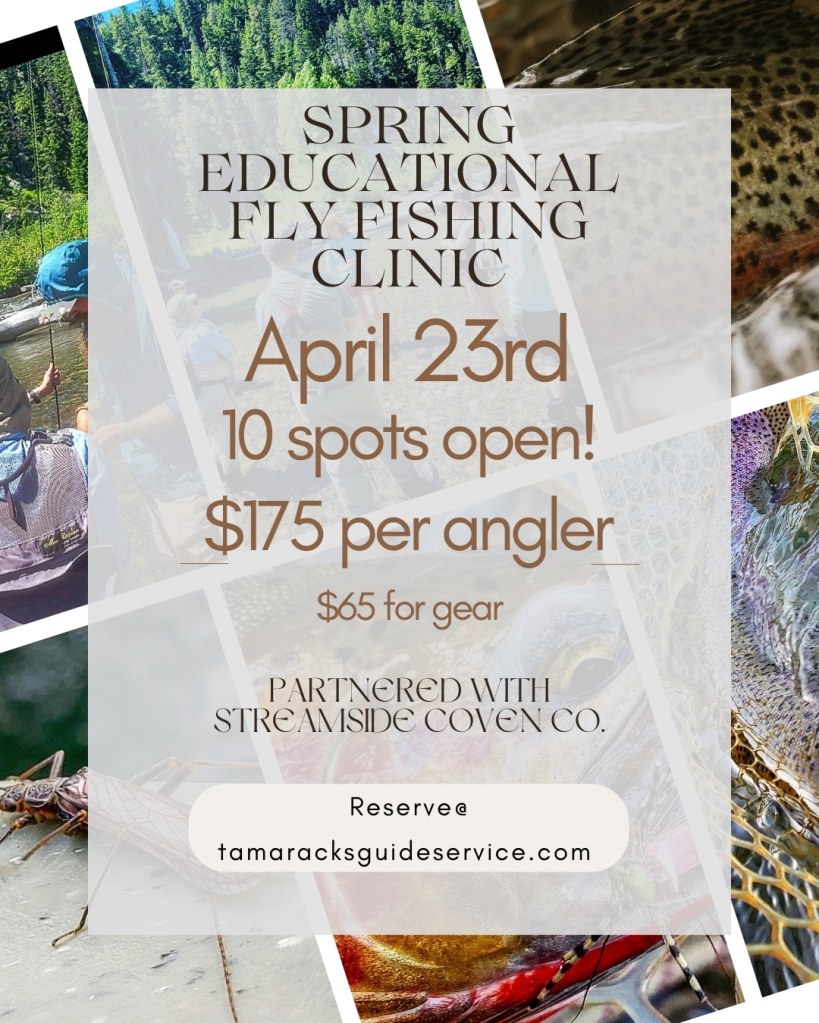
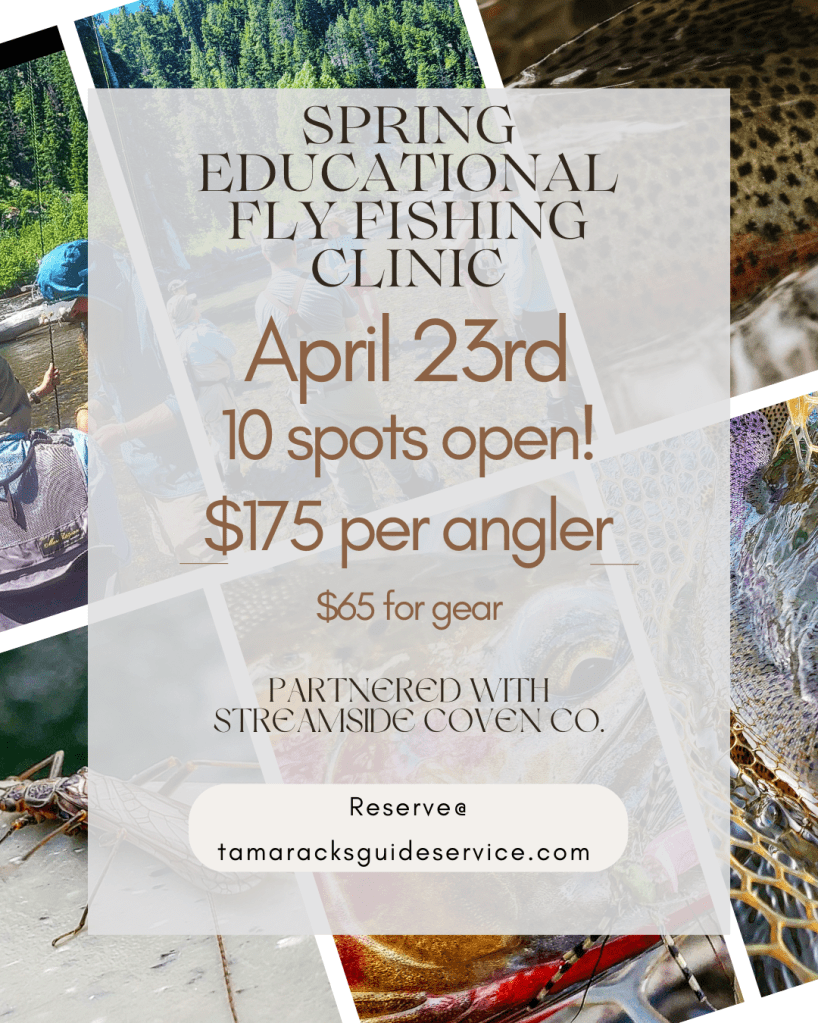
With dates getting grabbed up fast and early, I am already having to turn trips away. To help give more options for anglers, I’m also doing a second Spring Educational Clinic on April 23rd. I’ve got 9 of the 10 spots open for April. It’s $175 per angler, which is a great deal for instruction and 4 to 5 hrs on the water. My March Clinic filled up in a matter of days and had overflow. I’ll be partnering with Kristen and Streamside Coven Co. on this clinic as well, so come out to learn from two of the best guides on the Yak.

I’ll be gone May 25th through June 25th on a networking and fishing adventure in Michigan for the 2024 season. I’ll be back to guiding the Yak for July, so book your summer dates early.

Once October rolls through, I’ll be heading south to Florida with a new boat and chasing and learning the saltwater until the following spring. Things are moving and shaking, and I am expanding my business. The 2023 trout season on the Yak is a huge jumping off point for me, so the stroke and anticipation are rather high!

March has the 5th through the 10th open. The 13th and 14th, 21st, and 22nd and the 29th open. That’s it for March. Grab em while you can.

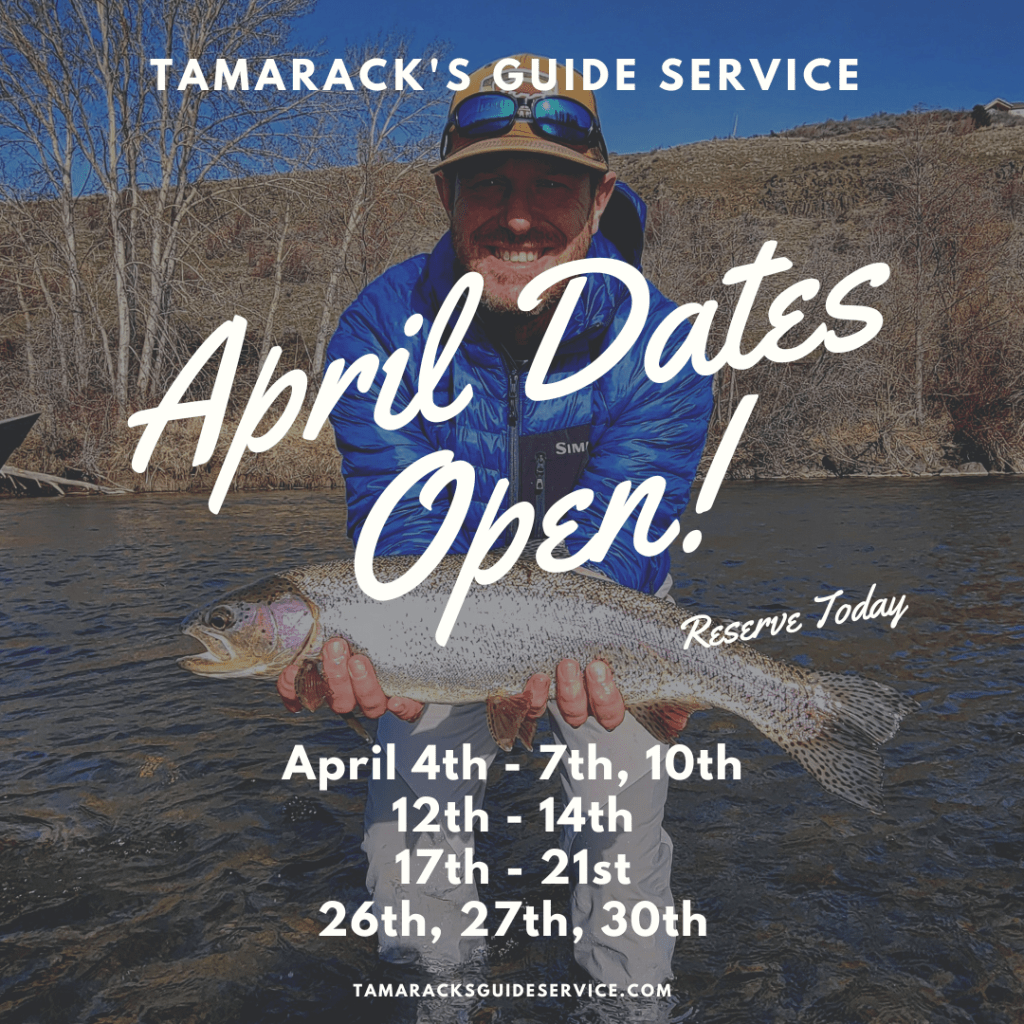
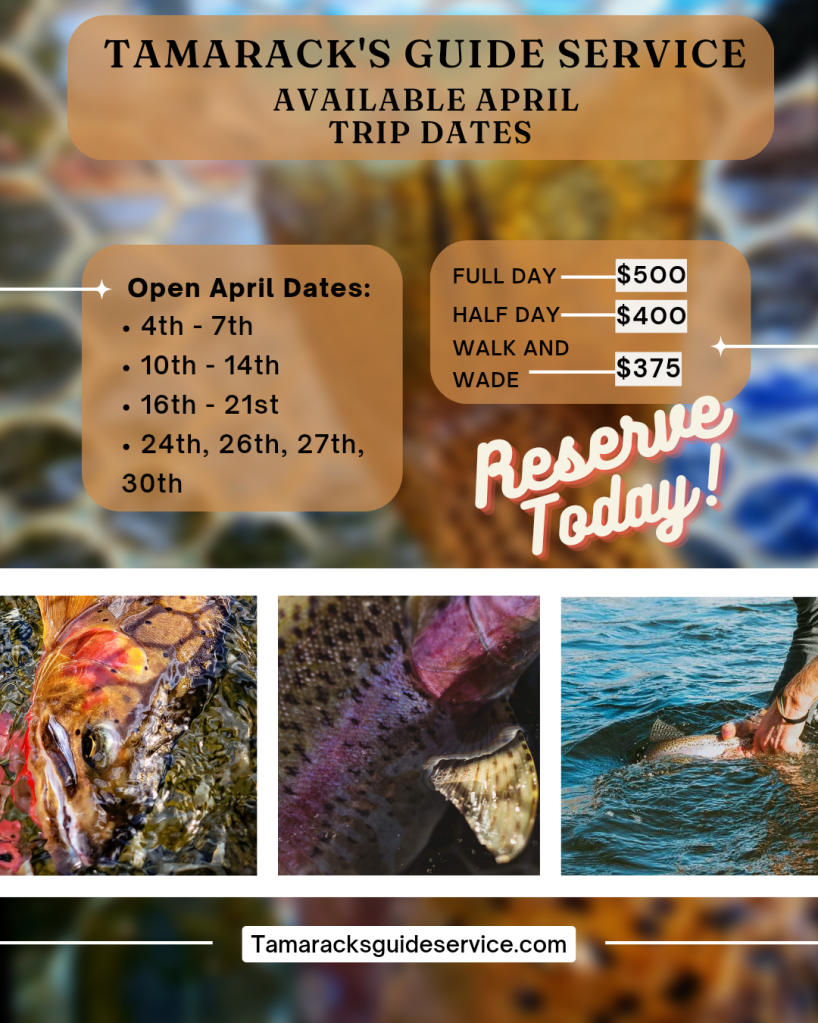
April has more with the 4th through the 7th, 10th through the 14th, 16th through the 21st. 24th, 26th, 27th, and 30th all open.

May has 1st through 4th. 6th through 11th and the 13th through the 20th open. CADDIS ANGLERS!

Our extended forecast and flow predictions look perfect for the spring, and I anticipate some superb fishing with a large chunk of our fish population being adult size that 15 plus inch good stuff for fish. Let’s go.

Reserve today. Grab a spot on the clinic on April 23rd. Half days, walk and wades, and full days are all options for anglers! Give me a holler, and let’s chase some trout together in 2023 anglers!

Awww ya, see ya riverside anglers.

Tamarack

Nets

I’ve had a thing about nets for a while as an angler. As a guide, it’s my most important tool.  It’s what I introduce anglers to fish with. As an angler, my net is the 2nd most important piece of gear I own after a fly rod.

Nets aren’t expensive. As long as it’s got a rubber net it’ll do just fine. A fancy net is not required but any net should be. I see too many anglers without a net riverside. This is a problem.

When you don’t have a net, it tells me one of two things. One: that you don’t expect to catch fish.  Which is a whole other blog post about confidence. Two: it means you catch fish but have no proper or respectful way to land them. Unless you are keeping your catch a net should always be how a fish is landed. Dragging catch and release trout onto the bank is bad.  Period.  There is no argument to be had. If you aren’t using a net and you’re dragging fish onto the bank to land them, you are doing it wrong.

There isn’t any real excuse not to have a net. Every fly shop, Cabelas, or mom and pop outdoor store has fishing nets for sale. Many under 30 dollars, which compared to what most anglers spend on gear, is nothing.  Even the shwanky fly shops got wicked nice nets for under 50 bucks. So buy a net if you plan on fishing.

Dragging fish up on the bank means a few things. It means you aren’t playing the fish strategically, meaning working the trout to the point where netting is possible. This means the trout is getting overly stressed. Playing trout up into the bank causes unnecessary stress in a few ways. The fish can be battered and bruised while fighting along the shallows and rocks, they have a higher chance of rolling and getting tangled in the line or dropper or trailer flies. It also means that an angler is unable to get the fish close enough to them that they can’t net it which means either the fish is too big for you’re set up and you need to up your rod weight, or you don’t deserve that fish yet. Part of fly fishing is playing the fish to net.  Fly rods are harder to land fish on and are designed for that purpose and process. Underweighting your rod looks cool in bent photos and makes fish feel bigger, but it’s not good for the fish.

Trout should be landed in less than 10 minutes. 2 to 5 minutes is the average for most fish. After 10 to 12 minutes of fighting an angler in any water conditions, trout mortality jumps to 30%. This means that within the next 12 to 24 hrs, that trout has a 30% chance of kicking the bucket unable to recover from its encounter with an angler. Add any other negative variable for the trout in that situation, and that percentage increases. Warm water temps, a higher percentage of dying after 10 minutes, heavy heavy current, same, dragging them up onto the bank and not using a net…same.

This is why I teach anglers to use proper weighted rods, play fish offensively not defensively, and use a net and play fish to the net. It takes practice and is an integral part of fly fishing and how it is different from other methods. It is a craft and skill to net fish. Just like a cast, a presentation, or playing a fish. Netting is a skill you need to master to be considered a good fly angler.

I’m not trying to shame or call anyone out. This is education with a little frustration. I’ve seen a lot of changes in this industry over almost 2 decades. There are a lot of new anglers with no nets. I used to keep a half dozen cheap hand nets just to pass out to anglers that I saw riverside without one. Buy a net.

Fly shops should also be selling you a net. If you buy a fly rod and still don’t have a net you need one. They are an easy upsell for fly shops, they don’t have to be expensive, and it is part of your tool kit for fly fishing. If your local fly shop doesn’t carry nets ask them too. If they are those fancy wood handled 200 dollar nets, go to the fishing gear store and buy a cheap frabill rubber net for 22 bucks. Learn to use it.

Netting requires you to counter and play fish by closing the gap. Not chasing a fish all over the place. Learning to move a fish into position depending on where in the water it’s hooked, learning to anticipate fish movements and how they react to the play of the encounter, the current a trout has to come through, the power of the rod, and an anglers physical ability all come into play. As I said, netting fish is a craft and a skill that is lost somewhere between casts and fly selections.

Learning to net fish solo is harder than in tandem. It takes practice and lots of failed encounters with fish as you learn to play them through trial and error. That’s experience. With a partner, you’re able to play the fish to the net with help, and the landing rate increases. But all of the skills can still be honed and perfected as you develop your fly angling abilities.

Fly fishing isn’t quick and easy. It has many layers with lots of steep learning curves. There are no real shortcuts. Guides help teach and get you leveled up faster. Good ones do. But nothing will beat personal experience and time on the water.

After learning the basic cast, fly fishing only opens up with more things to learn. From mending to setting the hook, to landing, to handling the fish. There is a lot. Netting trout is no different.

Wading clinics, trips, and even float trips always give guides the opportunity to teach playing and landing fish to net. Don’t hesitate to ask how to get better at it. It’s a struggle to get fish to net even for me some days. We still miss fish due to netting mistakes on my part as a guide. It happens. After a while, it happens less and less, but it still happens. Eventually, you land 80% of your hooked into fish, and that’s about as good as it gets.

If you’re an angler that finds themselves not getting fish to net while encountering a good number of them…it tells you that your skills at playing trout need fine tuning. Maybe the rod is too small. Maybe you’re playing them too offensively, maybe not enough. Starting to break down each encounter with a lost fish and finding the moment the fish got the advantage is how you learn to get better. It’s unique to each fish encounter, but eventually, you’ll start to see patterns in how they fight. How they move, what tension at what angle in that current gets the fish to behave this way. Then you can predict the trout, read the water for playing and landing the fish, and move the fish through the river with a purpose and goal instead of just hanging on and hoping they tire out. A tired fish is a fish that needs more time to recover, and that is done in a net. Not while tailing them on the bank. They need to be properly handled even after a 2 to 5 minute encounter so they have a higher survival rate. Otherwise, what’s the point of releasing them? The ability to do this for the trout is only through the use of a net.

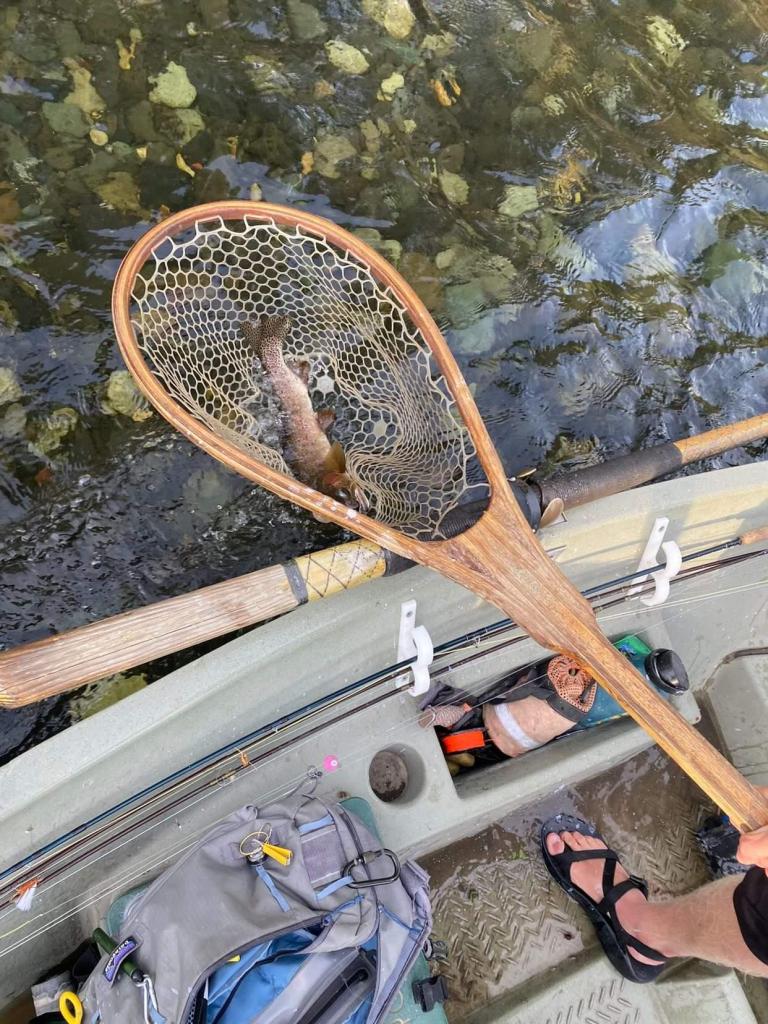
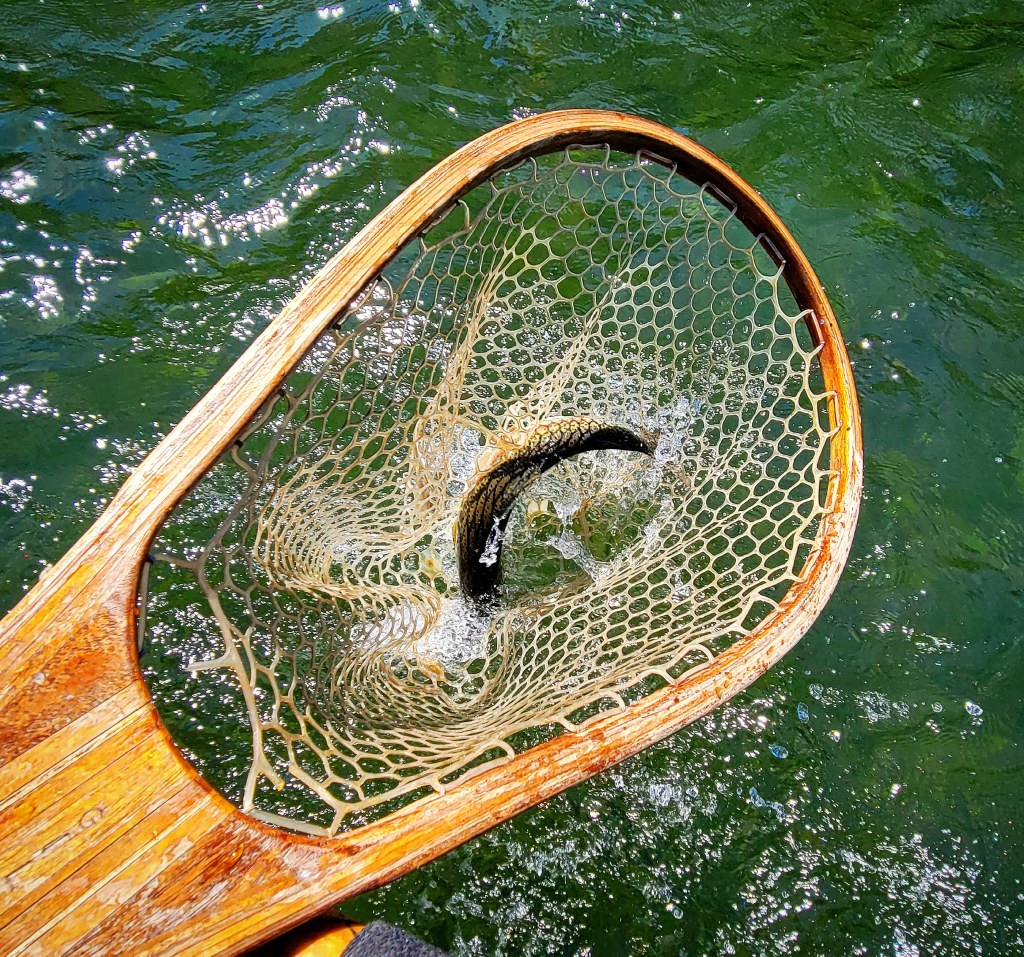
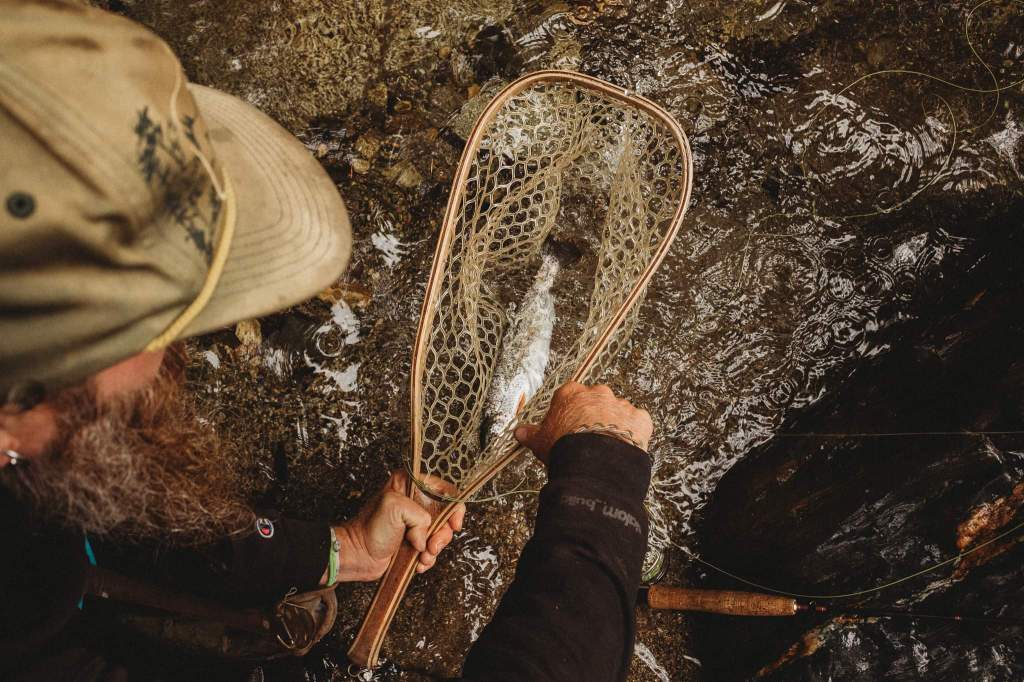
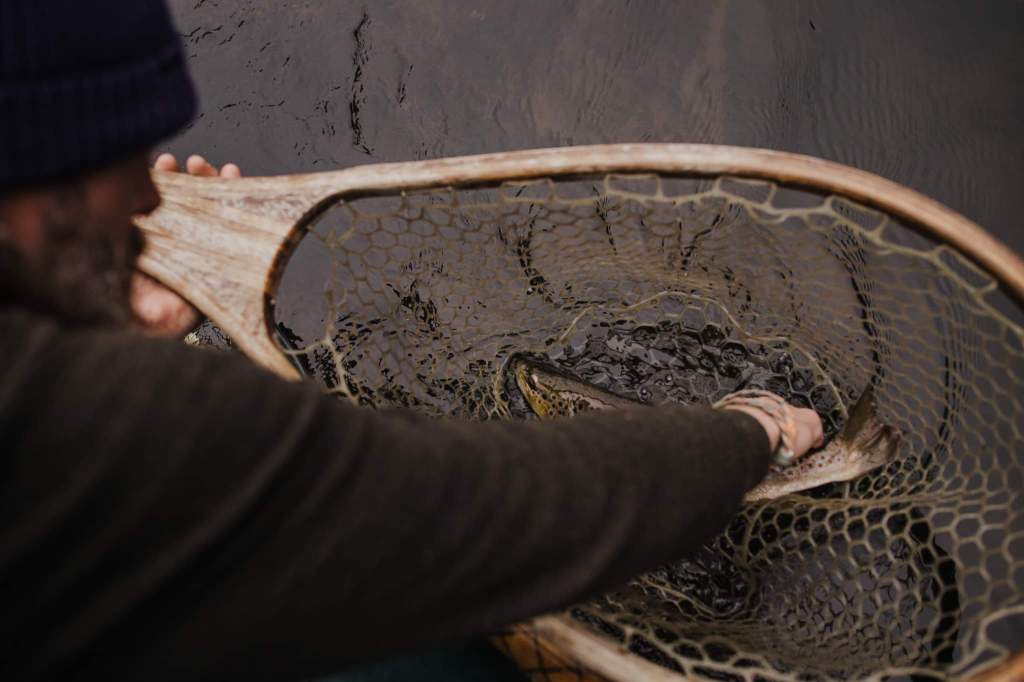
There are lots of nets. I wade with my boat net. Yes, my net is a 200-plus dollar net. It’s lasted me over 5 seasons of heavy use. It is over 4ft long, which gives me a huge reach and advantage when netting fish on foot or in the boat. It has a wide custom-made basket to scoop and net fish easier and quicker. And it looks nice because I like nice things for my troots and to show off fish to clients. Nets come in all shapes and sizes. I recommend a longer handled net or one that extends. Doesn’t have to be expensive, rubber net. That’s all.

So there’s my blog on nets before we get going. I want to see anglers with nets and no more photos of fish on the bank. Quit it. Get good at using a net or pay to be taught how to use one better. We take lessons for rowing, casting, tying, and netting fish is part of the skill set of a fly angler. So give it the necessary attention. I have become rather good at this skill. It was through a lot of trial and error and just days on the water missing fish. It’s part of the process of getting good at this gig. Learning and getting better at netting and landing fish is an advanced skillset, so be stoked to have made it there. You’re finding fish, now let’s get them to net like a fly angler!

I hope this helps persuade anglers to use a net. Don’t take offense if you haven’t used a net in the past. We are always learning and improving in fly fishing. There are lots of ways to play and land fish. I have developed my way over the years with inspiration and education from others.

A lot of thought goes into playing and landing fish as a guide when working with clients. It’s an advanced skill for a guide, too. We have to get really good at it, or we suck at our job in a way. I’ve landed thousands of fish over the years. I can tell you that it does get easier with practice. There is a point when setting the hook, playing the fish, reading the water through the encounter, and finding success and high landing rates clicks into place for an angler. Time, patience, missed fish, learning through trout encounters, and maybe a lesson or guide trip that teaches you some things about netting fish will pay out in the end.

See ya riverside anglers…with a net.

Tamarack

Spring Educational Clinic

I’ll be hosting another Spring Educational Fly Fishing Clinic on April  23rd with Streamside Coven Co.

Our March Clinic filled up quickly and had overflow, so get on this date fast. These clinics are a great way to learn from 2 experienced education focused guides who fish and guide more than any other!

We go over everything from water reading, casting, bugs, wading, netting, playing fish, nymphing, streamers, dries you name it we cover it for spring fishing for trout.

It’s $175 per angler. We can supply waders and boots and rods for an additional $65.

We have 10 spots open for April 23rd. Sign up today!

Tamarack

Here we go anglers!

It’s here. While the weather doesn’t seem super trouty at the moment, we are into March, and that’s the start of the season.

It’s snowing. We are at about 100% snowpack. Which is pretty normal for starting March. With at least this storm, and probably one more before April gets here. Which means we have water for the summer.

I’m looking at the next few days of weather, and it looks like Thursday this week it starts to warm up a bit and stop snowing. By Tuesday the following week, March 7th, we are in business. Next week, we have overnight lows staying above freezing for the most part and daytime highs above 40. That’s trout fishing weather for the spring.

Skwallas are 10 days out. Maybe less. But I anticipate that by mid next week, we start to see skwallas. Fish will be ready to feed after this wicked cold snap the past week. It’s a slow start to the season, but the days are here, and you don’t wanna miss them.

The next few weekends are going to be busy. Snag a week day and get more places to yourself to fish. That being said, we’ve only got a few days left open in March, and I’d like to get a few of them filled. Spring fishing is some of the best. Also, there is more opportunity at those trophy sized trout before high water comes in.

March 5th thru 10th is open. Right as things start to turn on. Could be that first banger skwalla fishing starting that week. March 13th and 14th, 29th, and 30th are all that’s open for March. Get em while you can.

It’s here, anglers! It’s finally here. We all know the procedure. Let’s get this 2023 season started. I haven’t guided since October. Only touched a dozen ornso fosh during the off-season. I’m hungry for chasing trout. Let’s F’ing go anglers!!

See ya riverside.

Tamarack.

Will it break!?

Fuck that groundhog. Little varmint was right. I hate the cold and the snow.  Winter has a bitter grasp on the river, and it’s been a slow slushy grind to the winter breaking.

Fishing hasn’t changed since December really, and I always say that February is a crapshoot, and this one was on par. A few okay days but mostly cold and slow.

We are having a more normal year. We’ve got nominal snow packs, and temps are just below average, which is a good thing. We have average precipitation, and in all honesty, the river is about where she should be for late February.   With the ice flowing down river again the past few days, the water temps will be hovering just above freezing and will take some time and rather warm days to come back up. Tis, why I’ve been pushing March and April, especially hard. Once it starts anglers…its gonna be real silly out there.

Skwallas will really start moving as we enter the 2nd week of March. As the conditions peak for the ‘hatch’ and the fish keying in on them really ramp up. It’s gonna  be cold leading up to those 45 plus degree days, sunshine, and overnight lows, staying above 32 degrees. Once they show up and we get 3 to 5 of them in a row,… that’s when shit gets silly. It’ll be like a light switch turned on, and it will happen quickly. I’m guessing the 2nd week of March is when it turns.

As March really gets going, we will get more food options, spawning behavior, and warmer water temps that sit right in the sweet spot for trout fishing. The BWOs, the March Browns, Skwallas, and that streamer game really pick up as we come into April.

April is money for the March Brown mayfly hatch. It’s a big hatch for the Yakima, it lasts for 3 to 6 weeks, starts like clockwork around 2pm everyday, and it’s some of the most consistent small dry fly fishing we get to partake in here on the Yakima. I highly recommend it. It’s quite nice, presents anglers with lots of opportunities to test their dry fly fishing abilities and get learnt by the guide and the trout during some really amazing fishing.

I love teaching anglers to headhunt in the spring. We get 3 good hatches for dry fly days with Skwallas, Bwos, and the March Brownies. Headhunting is one of the more challenging ways to fish for Trout and requires a lot of technical casting, water reading, and fly presenting skills as well as perfect timing, no missed hook sets, and the ability to play trout well. It also requires good listening skills. Headhunting is not to be taken lightly and is when I, as a guide, am at some of my most intense moments. I have high expectations and can get any skill level of angler to present and land these types of fish during these encounters. But it requires teamwork.

I look forward to this kind of fishing and the challenge guiding it presents.  Still to this day, I see guides and anglers pass these kinds of trout encounters up for easier opportunities and less challenging angling. I don’t pass rising fish.  We are gonna take shots. If there are risers, the bobbers get put away.

I still only nymph about 20% of the time during the spring. Streamer eats are more consistent and less boring in between takes. That being said, nymphing has its place, and I do rag on nymph fishing a lot. I’m not ashamed of it. It’s not my cup of tea, and in my experience, just as many fish are caught on dries as nymphs when done right.

In the spring, I use nymphing to teach how to break down a hatch.  When we know skwallas are moving during this time, there’s a reason to nymph specific water that trout would be holding in to feed. When March Browns come off at 2 pm every day, there is a 45-minute to 2 hr window prior to that time that gives anglers a perfect opportunity for excellent nymphing. I nymph with a purpose not with hope and to just comb the water column and bottom of the river. Nymphing has a time and place for me, and it’s used accordingly when it’s most effective and produces consistent results.

As April ends, we transition out of spring and into summer. Caddis through the 20th of May is what’s on the menu. And maybe Salmon Flies if we are lucky. I’ll be around until the 20th of May before I high tail it to Michigan until July for networking and setting up guiding for 2024. It will correspond with the Yakimas high water and bum-tastic fishing. I’ll be be back for proper summer time fishing in July.

So that’s what we have coming up. A slow creep into the spring. A big switch when it warms up in 6 to 10 days and an almost full spring calendar.

I won’t be on the Yakima full-time next season, anglers. I’ll be down south until March in 2024. Down payment on a new saltwater skiff is in the works. This might be your last chance to get guide days with me during specific hatches like Skwallas and March Browns moving forward. I’ll always guide days on the Yak, but they won’t be all of them. So come out for the 2023 season and chase some wild trout. I’ll teach ya stuff, make it so you can find success without a guide, and have a better understanding of fly fishing and trout.

I’ve got days open those first 2 weeks of March and lots in April and May still. See below.

March: 1st-3rd, 5th-10th, 13th-14th.

April: 4th-7th, 10th-14th, 16th-21st, 23rd, 29th-30th.

May: 1st-4th 6th thru 20th. Caddis Hatch around thr 10th. Get ’em.

I hope to see ya riverside anglers. The season is about to start.

Tamarack